
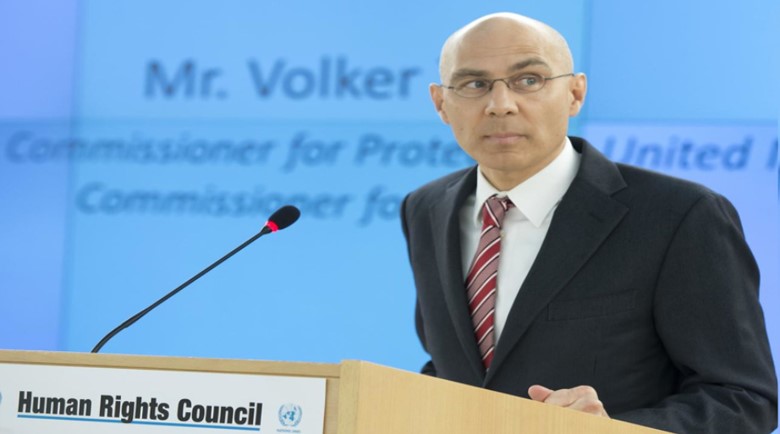
Volker Türk has once again lowered his tone against the de facto government. The recent presentation of the annual report by the High Commissioner for Human Rights has, once more, left a feeling of unease in the corridors of Geneva: the agenda of the UN’s highest human rights authority seems to have entered another deliberate phase of appeasement, marking a thunderous silence regarding the situation in Venezuela.
To understand the gravity of the current silence, one only needs to look in the rearview mirror. In June 2025, the High Commissioner did not hesitate to dedicate a substantial space to the Venezuelan crisis, denouncing the severe post-election repression following the elections of July 28, 2024, with reference to arbitrary detentions, enforced disappearances, and patterns of torture. In the oral update of September 2025, the OHCHR maintained the pressure by denouncing the suffocating closure of civic space. Even in March 2026, Türk raised his tone against the allegations at Rodeo I and Fuerte Guaicaipuro, provoking a furious reaction from the ruling party’s foreign ministry, which accused the office of having an “immoral bias.” In addition to attacking the crisis in public services, salaries, food, health, water, and sanitation, the High Commissioner demanded the return of his office with a full mandate and, for the first time, called for cooperation with the Independent International Fact-Finding Mission (FFM). Just three months ago, it was Türk who revealed that, regarding the amnesty law, his office had not received an official list of released individuals, nor access to detention centers, demanding transparency on the matter.
It is evident that a surprising turn, to say the least, has occurred. Omitting Venezuela entirely from his global report is not a bureaucratic oversight, but rather a political concession. It is no coincidence that the de facto government’s response to this omission was followed by an intervention stripped of its traditional hostility and full of polite gratitude toward the High Commissioner’s report. Such a profound contrast makes it clear that silence is paid for with mutual complacency and that human rights are also used for purposes that may be different from their protection and defense.
The underlying problem lies in this modus operandi and its consequences. Nor is it the first time that the High Commissioner, in his push-and-pull game with the de facto government, falls into the trap of the carrot of an on-the-ground presence—which never arrives and is always conditional—in exchange for submission tailored to convenience. Under the pragmatic premise of “maintaining access” to the country, the office is leaning toward a logic of downward negotiation that does not even guarantee a visa to operate stably.
Currently, the terms of the OHCHR’s presence are governed under an expired Memorandum of Understanding, albeit with an extension. International officials depend on short-stay visas, which is nothing short of a regulatory noose with which the Rodríguez regime, just like the Maduro regime, subtly extorts the UN narrative and, in all probability, dictates what it can or cannot do domestically while talks continue. Instead of reacting loud and clear to the progressive worsening of conditions on the ground, the OHCHR leadership shows signs of focusing on securing a bare minimum that would be acceptable to them—such as a mere formal extension of the memorandum or slightly longer stays for their staff—without structural improvements, which require creating the conditions that lead to an agreement with sufficient guarantees of permanence and deployment. If there is no political will from the regime, the High Commissioner should shift to a pressure strategy to foster negotiation, without sacrificing at any point the denunciation of atrocious crimes and the humanitarian crisis.
This modus operandi of preserving the link with the host country above human rights is exactly what has broken the UN human rights protection system. The organization’s history should be its primary source of learning. In its report Unlearned Lessons, AlertaVenezuela recalled that during the final phase of the war in Sri Lanka (2007–2009), the UN incurred its first institutional failure by maintaining a complicit silence in the face of the atrocities committed. This led Ban Ki-moon to commission a study which established that the UN “did not adequately invoke the human rights principles that are the foundation of the system but rather seemed to do what was necessary to avoid confrontation with the government.” It is the High Commissioner’s responsibility to prevent the organization from repeating the errors of the tragic experiences of Sri Lanka and Myanmar in Venezuela, making the UN system a political instrument at the service of power. Therefore, Venezuela cannot be silenced, nor its crisis relativized in the face of dialogue attempts that have been thwarted for months. Instead, Türk must develop a political profile to create tension with the regime when necessary.
It is true that this week the High Commissioner issued a critical report on Venezuela. Türk expressed that, although several releases of people arbitrarily detained after the 2024 elections were recorded, the authorities maintained a stigmatizing rhetoric and an Amnesty Law was approved, which is questioned for its opacity, limited scope, and its intention to destroy essential evidence of the crimes committed. Similarly, he continued to document serious violations such as enforced disappearances and clandestine transfers of detainees, accompanied by torture, as well as a substantial increase in the number of citizen protests and internet censorship. This, however, does not invalidate the previous criticism. It is part of his job, and at the same time, the High Commissioner must understand that agreeing to remain in a country under an expired, still-secret memorandum, and with limited visas, reduces the highest human rights authority, as well as the victims, to the status of a hostage of the de facto government.
The inevitable consequence is operational paralysis disguised as diplomatic prudence. From AlertaVenezuela, we have reiterated in several editions that there must be a limit, red lines, that the so-called strategy of silent diplomacy cannot cross. Not only that. The experience of engaging with the regime, as well as with other authoritarian governments, is already sufficient to explore at least different lobbying strategies with States, civil society, and allied organizations to allow for an alternative search for significant progress. Furthermore, with no real improvements in democratic freedoms and the repressive apparatus remaining intact, the extension of the status quo only benefits the regime, which instrumentalizes the UN’s presence as a seal of international legitimacy without paying any political cost, and even detracting from other bodies such as the FFM.
Venezuela has deployed huge sums of money in international propaganda and lobbying to sustain a narrative of “normalization” and apparent multilateral “cooperation.” However, those narratives have lost strength, crumbling under the scrutiny of facts and the persistence of the crisis. That is why, knowing that its myths of recovery and dialogue no longer convince donors or democratic States, official diplomacy mutated its tactics. The current goal is not to convince the world that the Rule of Law prevails in Venezuela—which has long ceased to matter because there is no longer the slightest respect for formalities, as the FFM warned—but rather to deactivate the strictest accountability mechanisms. By staging a “harmonious” relationship, submissive to convenience and exempt from friction with Volker Türk’s office, the de facto government intends to demonstrate to the international community that criminal investigation and determination mechanisms for crimes against humanity (such as the Fact-Finding Mission and the International Criminal Court) are unnecessary and interventionist.
If current conditions with the OHCHR remain unchanged, there are no prospects for short-term improvements. With the cosmetic concessions made by Venezuelan authorities in recent months—such as partial conditional releases or half-baked legislative reforms without substantive consultation—the High Commissioner must push for more on the ground and demand it. Furthermore, he must seriously consider what the balance of his management is, especially when entering this perverse dynamic of appeasing or changing his discourse.
The OHCHR cannot forget that its mandate is not to administratively survive within an authoritarian territory, but to defend with authority the rights of those who have no voice. Ceding to the blackmail of visas and administrative deadlines condemns the UN to irrelevance and turns its indifference into harm to the population. We ask the international community to influence this matter, ensuring that Venezuela counts, once and for all, on a genuine country office equipped with a full mandate and without restrictions.