
History demonstrates that transitions from authoritarianism to democracy are never sudden or linear events. They don’t occur at a precise moment, nor are they decreed by the will of a single actor. They are complex processes, with advances and setbacks, where political, economic, institutional, and social factors converge, and only together can we affirm that a country has managed to leave behind an authoritarian regime.
In the Venezuelan case, the current situation presents an unprecedented feature: the main figure of the regime has been displaced, but the apparatus that sustained authoritarianism remains practically intact. The formal leadership has changed, but the power structures, the control mechanisms, and the interests that have dominated the country’s political life for more than two decades continue to operate with remarkable continuity.
This scenario raises profound questions about the true nature of the political moment Venezuela is experiencing. Are we witnessing the beginning of a democratic transition or simply a reconfiguration of the same authoritarian system?
The three-stage Plan: a reasonable, yet fragile roadmap
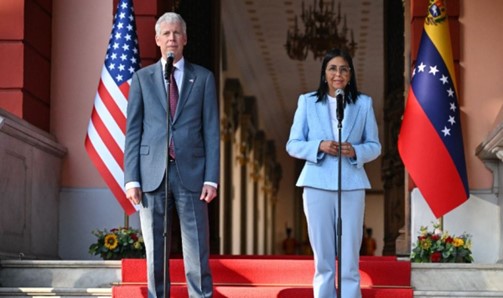
Various international actors, especially the United States, have proposed a three-stage roadmap to guide Venezuela toward a democratic regime. Analysts have described the proposal as reasonable and technically feasible. However, as is often the case in transition processes, “the devil is in the details.”
The questions that arise are inevitable:
• Will it truly be possible to move toward the democratization phase?
• Are all the actors involved committed to this objective?
• Can a regime that has survived thanks to its iron grip on power transform itself from within?
In this context, Delcy Rodríguez’s recent overtures to the United States have generated mixed interpretations. For some, they represent a pragmatic attempt to ensure stability and international recognition. For others, they are tactical maneuvers aimed at preserving power without altering the essence of the system.
Oil as a Critical Variable: Engine of Change or Anchor of Authoritarianism?
The potential recovery of oil production introduces an additional element of uncertainty. Historically, oil revenues have been used by Venezuelan governments—both democratic and authoritarian—as a tool to consolidate political power.
A central question then arises:
Will an improvement in oil production and revenues facilitate a democratic transition or, on the contrary, strengthen the regime’s capacity to perpetuate itself?
The answer will depend on institutional transparency, the use of resources, and the existence of real checks and balances, and such checks and balances do not exist today. Without these elements, oil could once again become a mechanism for prolonging authoritarianism.
Delcy Rodríguez and Her Own Past: Rupture or Continuity?
The figure of Delcy Rodríguez occupies a central place in this political moment. Her career is marked by decisions that have contributed to the impoverishment of the population, systematic repression, and human rights violations widely documented by United Nations agencies.
The question is whether she is willing—and capable—of breaking with that past to become a figure who facilitates a genuine democratic transition.
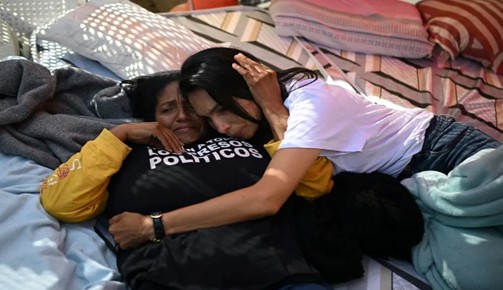
Just over a month into her term, her conduct is ambiguous. On the one hand, she appears conciliatory and open to dialogue with international actors. On the other, she maintains practices that generate distrust, such as failing to release all political prisoners as promised and passing an amnesty law. Expectations were enormous. However, the process has become bogged down in confusing definitions and deliberate obstacles that have prevented concrete progress. This ambiguity not only erodes the credibility of the de facto government but also weakens public confidence in the possibility of a real transition.
A transition that is not yet a transition
The Venezuelan situation is at an intermediate point: too much movement to speak of stagnation, but insufficient transformation to speak of a transition. The removal of the regime’s main figure has not, so far, entailed a substantive modification of the political system.
For a democratic transition to occur, verifiable changes must take place in at least three dimensions:
1. Institutional: Dismantling of the repressive apparatus, judicial independence, electoral guarantees, and respect for the Constitution.
2. Political: Genuine pluralism, electoral competition, and freedom of association.
3. Human Rights: Cessation of repression, release of political prisoners, justice for victims, and repeal of legislation that restricts rights.
None of these dimensions has shown significant progress. On the contrary, signs of continuity persist, compelling us to view the process with caution.
In this context, the international community has a crucial role. It is not a matter of intervening or imposing solutions, but rather of firmly and consistently supporting a process that is still fragile and reversible. International monitoring, the demand for compliance with commitments, and support for Venezuelan civil society are essential to prevent this moment from becoming a mere reconfiguration of authoritarianism.
The international community must remain vigilant, demand verifiable progress, and support those within Venezuela working for a genuine transition. The country faces a historic opportunity, but also a profound risk. The outcome will depend, to a large extent, on the pressure, support, and solidarity of the democratic world.