
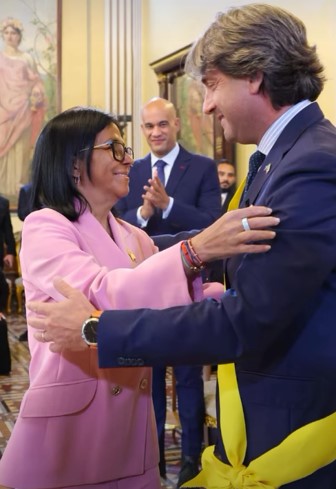
The departure of Gianluca Rampolla, who completed his five-year mission as UN Resident and Humanitarian Coordinator in Venezuela in early August 2026, generated mixed and divided reactions within the country’s political and social landscape.
Rampola’s departure was met with high honors by the de facto government, which awarded him the Order of Francisco de Miranda, First Class, despite the fact that UN officials cannot receive such awards personally, and Rampolla did not clarify what he intended to do with it.
In contrast, the official’s departure provoked strong criticism from sectors of public opinion. Activists and relatives of political prisoners or disappeared persons reproached him for a complacent stance toward the Nicolás Maduro government. A visible example was the public outcry from the mother of Hugo Marino (disappeared since 2019), who criticized Rampolla for leaving without having effectively intervened with the State to obtain answers about her son’s case. Although Rampolla himself argued in interviews with media outlets like El País that receiving complaints from both political sides meant he was doing his neutral job well, opposition sectors perceived his validation of government figures during the earthquake emergency as an endorsement of the official narrative. Many also questioned his participation in the “World Congress Against Fascism, Neo-Fascism and Similar Expressions,” organized by Nicolás Maduro in September 2024, an event considered one of the most controversial moments of his tenure, at a time when the de facto government had launched its largest wave of repression following the electoral fraud, labeling the opposition as fascist and terrorist.
The AlertaVenezuela report, “Lessons Not Learned,” had questioned the management of the former UN coordinator in Venezuela, Peter Grohmann, denouncing a “silent diplomacy” that concealed humanitarian data and minimized human rights violations to maintain cordial relations with the government. Unfortunately, and despite warnings, Rampolla engaged in the same practices as his predecessor, repeating the pattern of “silent diplomacy” and excessive institutional complaisance that characterized Peter Grohmann. Like his predecessor, Rampolla focused his efforts on maintaining open communication channels with the government, even at the cost of sacrificing the UN’s human rights pillar. The awarding of the Order of Francisco de Miranda at the close of his mission demonstrated that the diplomat preferred the comfort of a cordial relationship with the government to a firm stance demanding compliance with Venezuela’s international obligations.
During Rampolla’s tenure, the term “constructive ambiguity” was coined, a term questioned at the time by AlertaVenezuela. This term supposedly aimed to ensure a liaison mechanism that would allow for dialogue and intervention with the authorities on relevant issues. As time passed, it became clear that ambiguity prevailed over constructive engagement.
It was recently announced that Canadian-born officer Álvaro Rodríguez was appointed as the new United Nations Resident Coordinator in Venezuela. Rodríguez arrives in Caracas with extensive experience in multilateral affairs and crisis management, having built much of his career directly within the United Nations system and various international institutions.
The new representative assumes his duties in the context of high operational demands in the country, with responsibility for the post-earthquake plan and the coordination of assistance. Furthermore, the team from the Office of the United Nations High Commissioner for Human Rights (OHCHR) in Venezuela is integrated under the structure of the Resident Coordinator’s Office.
Rodríguez faces the challenge of moving away from so-called constructive ambiguity to overcome the criticisms of complicity and “silent diplomacy” that plagued Grohmann and Rampolla. To achieve this, he should implement urgent changes to his institutional strategy, including:
- Report with complete transparency the bureaucratic obstacles and political restrictions faced by international agencies and local NGOs on the ground.
- Break the silence surrounding flagrant human rights violations, balancing closed-door meetings with clear and forceful public statements.
- Avoid validating the official narrative by rigorously comparing state data and figures with independent sources before issuing assessments.
- Use the political weight of his position to advocate visibly and actively for the release of political prisoners and the cessation of harassment against human rights defenders.
- Design strict auditing mechanisms to prevent UN assistance programs from being used by the government as tools of social control or political propaganda.
- Collaborate with the Office of the High Commissioner for Human Rights (OHCHR) in the search for gradual and progressive mechanisms that facilitate the full establishment of a country office for human rights.
Achieving these changes requires a proactive international community that contributes to restoring the core of the UN operation in Venezuela, in accordance with its founding principles.