
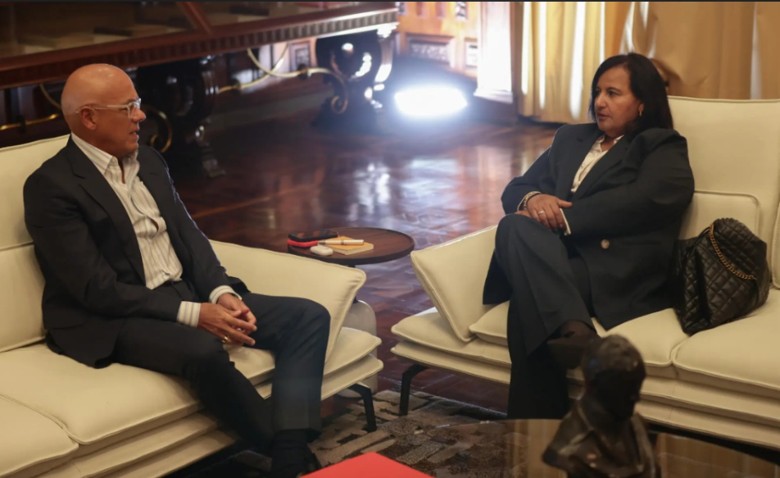
Venezuela is heading toward a new attempt at dialogue between a sector of the opposition and the de facto government. On August 1, Dinorah Figuera and Jorge Rodríguez each published separate statements announcing that they had agreed on a work agenda within the framework of a dialogue process whose questions and reservations continue to raise doubts. The actors presenting themselves as the leaders of this process are, on the one hand, Figuera, who still claims to be president of the National Assembly despite the expiration of her constitutional term in 2020 and who continues to hold the position by virtue of recognition from the United States, as if public office, especially one based on popular will, depended on the decision of a foreign government; and, on the other hand, Jorge Rodríguez, president of the legislative body and second-in-command of the de facto regime led by his sister.
It wasn’t a joint statement, but two, and that’s where the differences begin to emerge. Rodríguez referred to “an inclusive political dialogue for the benefit of the country,” while Figuera referred to “a dialogue process for the democratic transition in Venezuela.” These contrasts are self-evident and demonstrate that the parties have begun talks without being able to agree on a minimum common language to frame the process. This is no irrelevant; beyond the initial mistrust, it reveals each actor’s tendency to pander to their audiences, which could undermine this effort at its inception.
On a more formal level, the most serious indicator lies in the sector representing the opposition in this proposed dialogue. A negotiation cannot achieve genuine results, if it achieves any at all, if it marginalizes the political force with the greatest legitimacy and popular support in the country (such as the leadership embodied by María Corina Machado and the majority democratic bloc). We have already warned that transitions imposed by foreign powers and negotiated in the absence of the opposition and civil society have failed. Accepting a dialogue tailored to the regime condemns any political approach to mere pretense and inevitably leaves many issues unaddressed. The problem isn’t with Figuera and his role in this process, but with those who seek to validate a formula that excludes the main opposition forces.
Another critical observation concerns the agenda. Much could be said about its vague, imposed, or exclusionary content. As we noted in a previous edition, it is troubling that the conversation’s backdrop stems from the natural disaster, as if nothing that existed previously in the country was sufficient reason to discuss and generate structural changes. While attention to the victims of the double earthquake is necessary and valuable, it overlooks all the victims of state terrorism during these 27 years of Chavismo-Madurismo-Rodrigato regime. Approaching a dialogue initiative, as has happened with all the others, without dedicating a single line to political prisoners and the thousands of victims still awaiting reparations, is another offense that denigrates not only their families, but all Venezuelans wherever they may be, because they know that unpunished crimes provide incentives to repeat them in the future.
Similarly, the statement from both sides insists on the idea of “strengthening democracy,” instead of democratizing. As we warned in a previous edition, this shared objective could suggest that efforts will be minimal, based on the assumption of a democracy that already exists and only needs reinforcement. Reconciling the proposal to strengthen democracy with Figuera’s stated objective of undertaking a democratic transition appears challenging, as they refer to essentially different processes.
The relevant issue is that, alongside the substance of the process, the methods used to conduct dialogue are of fundamental importance, especially in Venezuela, which has undergone multiple attempts to overcome its political crisis, on no fewer than 12 occasions with some external support. These include Mercosur, Caricom, Unasur, Rodríguez Zapatero in 2014 and in 2017 (Dominican Republic), Barbados/Norway, the Vatican, the OAS, the Lima Group, the Contact Group, Mexico/Norway, and Barbados II. The instances have been so numerous and varied that at least some lessons must have emerged from these experiences.
In order to prevent this new political rapprochement from becoming another exercise in tactical oxygenation for the regime and dismantling of the opposition, it is necessary to analyze the structural failures of the past in light of Venezuelan political dynamics and provide some evidence-based guidelines to channel the role of the international community within this complex process of a tutelary dictatorship.
The first lesson to be learned should be the asymmetry of incentives for negotiation. The de facto government has historically resorted to dialogue under immediate pressure (sanctions, protests, humanitarian crises, and now a natural disaster) only to buy time, dismantle street mobilizations, and fragment the opposition. Once the immediate pressure dissipates, it reneges on agreements without paying a significant political or economic cost.
Since for the regime, the success of a democratic negotiation would mean losing power, its real incentive is not to reach an agreement for change, but to manipulate the conversation to remain in government. For the opposition, the incentive is to restore institutional order. If democratizing the country implies an existential risk for the ruling elite (losing all their wealth or facing international justice), their tendency to block a genuine transition will always be greater than any partial concession offered.
A structural condition, then, must be an incentive scheme with exit guarantees that truly alters the cost/benefit calculation for the ruling elite, so that the costs of not reaching an agreement are so high for the authoritarian regime that its least bad option is to accept a set of democratic rules. At this point, the international community and the opposition must coordinate a strategy of incremental pressure and consider mechanisms for transitional justice, guarantees of coexistence and future representation, and certain safeguards for property or personal assets, without affecting the human rights of victims or turning the State into an instrument of reverse persecution in the future.
The second lesson learned should be the clear imbalance in the cost/benefit analysis for both sides. In the Venezuelan case, the imbalance is significant and works against the opposition. If the regime signs an agreement and then fails to comply, the opposition lacks the tools to enforce what was agreed upon. Therefore, the regime does not pay a high price for breaking its word, while the opposition risks losing its political capital every time it sits down to negotiate. Furthermore, for the country’s democratic forces, time is working against them, contributing to attrition, the humanitarian crisis, and various social problems. For the regime, time at the negotiating table is on its side, as each month of dialogue without results is another month of continued rule and a further erosion of social and international pressure.
A structural condition must therefore be ensuring mechanisms for verification and enforcement. Unlike previous processes, this time the United States is assuming the role of a tutelary power; however, it is beyond question that the Trump administration will only intervene if the issue under discussion matters to them or if they believe it could improve their own economic interests. Given that the Trump-Rodríguez alliance seems to be progressing very well, it is crucial to exert influence beyond the US government, particularly before Congress and various groups with the capacity to influence its decision, including other states.
Additionally, this presents another historic opportunity for the UN under outgoing Secretary-General Guterres, which has operated under a logic of reputational calculation and silence in the face of various conflicts, to take a more active role in demanding concrete results and strategically influencing the United States and other countries that support the democratic path in Venezuela. The financial and reputational crisis facing multilateral organizations like the UN will continue to be a noose around its neck until the Secretary-General himself and high-level agents dare to reaffirm the importance of its mission and make it effective in the scenarios for which it was conceived: states in crisis or with serious conflicts. The UN was not created with Nordic countries or relatively stable democracies in mind. Without multilateral actors, it will be very difficult to build a broad coercive force capable of increasing the costs imposed on the de facto government each time it decides to evade its commitments, nor will it be possible to set institutional guarantees to sustain long-term agreements.
The verification and enforcement mechanisms adopted must be grounded on formulas of gradual and reversible exchange between progress and relaxation. Each step forward in reinstitutionalization (for example, the qualification and registration of candidates, the full release of political prisoners, a verified electoral calendar, the reconstitution of the electoral body or the judiciary) is “paid for” with a milestone of pressure relief (for example, business licenses, the gradual lifting of financial or personal sanctions against certain officials, measures recognizing certain authorities, the restitution of rights, among others). The key is to understand that the measures must be reversible, with the capacity to be intensified in case of non-compliance, and conditional upon the achievement of verifiable and relevant milestones in the agreed-upon political and institutional timetable.
The third lesson learned should be the reduction of dialogue to a partisan political matter. No negotiation scheme involving only political actors has been successful. The design of this new cycle must include organized channels to ensure that human rights demands, including reparations for victims, are not subject to negotiation or “favors” on the political agenda. To achieve this, there is no more authentic and democratic way than guaranteeing the meaningful participation of civil society, along with communities and families of victims, who must be considered in the different roles of the process, far from being relegated to secondary positions or having little effective influence.
The lessons learned have also allowed the international community to have early warnings. The development of the dialogue can be objectively and evidence-based evaluated according to various criteria, such as i) Any delay in establishing an electoral and political timetable with guarantees for all parties and voters; ii) The continuation of disqualifications, disappearances, and arbitrary detentions; iii) The use of dialogue to demobilize citizens (including protests, associations, and other forms of popular organization). iv) Sustained non-compliance with international human rights obligations (in particular, the denunciation of the Rome Statute and other international treaties); iv) or even if there were advance concessions to the effective implementation of agreements by the de facto government; among many other criteria. A process that persists without resolving at least one of these aspects can only be a sham.
Drawing on the experience accumulated over these years, AlertaVenezuela calls on the international community, Venezuelan civil society, and other actors interested in democracy in Venezuela, to promote, from their various roles, a political negotiation process that effectively incorporates the lessons learned and provides sufficient indicators and guarantees for the future, without reproducing the regime’s narrative that conditions the content and scope of future agreements (democratizing vs. making cosmetic adjustments), nor validating the exclusion of the majority opposition and civil society. It also calls for the rejection of any proposal built on impunity for serious human rights violations, as well as partial agreements that involve an excessive sacrifice for the democratic cause in exchange for temporary and meager gains, such as power-sharing schemes that institutionalize one-party rule or that prevent the free exercise of the opposition by granting smaller quotas in the public sphere.