
Despite the vast sums of money spent on propaganda, the narrative that the de facto government is attempting to impose in Geneva and The Hague has failed to achieve its intended goal of portraying victims as terrorists and perpetrators of crimes against humanity as victims. Three clear examples occurred this week.
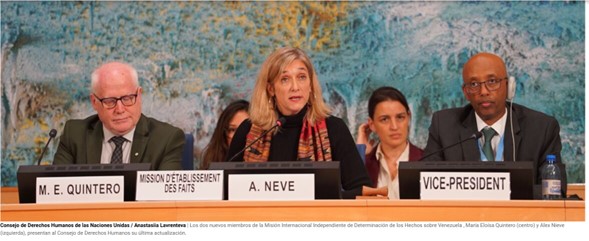
First, on March 12 and 13, the Independent International Fact-Finding Mission on Venezuela (FFMV) presented its oral update to the Human Rights Council, followed by the customary interactive dialogue. While many countries welcomed the amnesty law, a critical perspective persisted, reflected in demands for its swift implementation. They stressed that the law must serve the victims of repression and contribute to achieving justice, reparations, and guarantees of non-repetition.
The representative of Venezuela, who on this occasion was a lower-ranking official from the Mission in Geneva, did not even take the opportunity to try to explain the supposed benefits of the amnesty law or the exorbitant number of people who, according to Congressman Jorge Arreaza, have benefited from it; nor did he refer to the so-called Program for Peace and Democratic Coexistence. His intervention was limited to the already hackneyed attack on the International Mission, its budget, and its supposedly biased and selective nature. With this line of argument, the representative of the de facto government made it clear that his priority is the defense of the regime, not the fulfillment of the victims’ expectations of justice.
Many countries also recalled that there are still a large number of political prisoners who have not benefited from this law and who are being held in deplorable conditions of detention, subjected to torture and cruel treatment, while being denied timely medical attention. The moment was opportune to remember the many foreign prisoners or those with dual nationality who have been released and the many others who remain as hostages. The harrowing testimonies of foreigners who have left Venezuelan prisons are, quite literally, going viral around the world. It is no longer Venezuelans who are recounting their tragedy; it is nationals of different countries who are telling of the torture suffered by people like themselves, with their same language and customs. Hostage diplomacy is becoming a boomerang against those who designed this perverse strategy.
Two other recurring themes in the speeches were the closure of civic spaces and the call to allow the return of the Office of the United Nations High Commissioner for Human Rights (OHCHR) to Venezuela, as well as cooperation with Fact-Finding Mission. The Oversight Law, or anti-NGO law, far from silencing civil society, has garnered it more allies demanding the opening of civic space in Venezuela. Meanwhile, the expulsion of the Office of the United Nations High Commissioner for Human Rights (OHCHR) continues to generate protests, as no one accepts the partial and silent returns that have taken place in recent months.
In The Hague, a narrative that sought to portray Venezuela as a victim also collapsed that week. In its attempt to downplay the crimes against humanity committed, the de facto government disseminated for years the story that US sanctions generated crimes in Venezuela that fell under the jurisdiction of the International Criminal Court (ICC), including murders, exterminations, deportations, persecution, and other inhumane acts constituting crimes against humanity. This new propaganda tactic has now come to an end. On March 12, the ICC Prosecutor’s Office closed its preliminary examination of Venezuela II Situation, ruling out opening an investigation. The Office stated that the information transmitted, for the purposes of criminal law, does not demonstrate a sufficient causal relationship between the sanctions and the alleged crimes, nor that these were carried out with the necessary intent, so there is no reasonable basis to believe that any of the crimes of the Rome Statute have been committed.
The regime led by Delcy Rodríguez will have the opportunity to correct what has been a persistent strategy of revictimizing and harming victims in Venezuela, or to continue along this path of obstructing international justice. This will become clear within the next 90 days, during which it can decide whether to request Pre-Trial Chamber I to review the Office’s decision not to continue the investigation. It would be in its best interest, however, to close this bitter chapter of attacks against the ICC and begin cooperating with its only ongoing investigation, putting into practice a supposed renewed spirit of coexistence and peace that it seeks to foster with the amnesty law. Venezuela remains challenged regarding its international commitments, the only ones that will determine whether it is genuinely willing to create the conditions for a democratic transition, or merely to realign itself with power.
Its authoritarian stance, from which these false narratives arise, is proving increasingly costly. The High Commissioner for Human Rights, in his oral update, demanded the return of his office with a full mandate and, for the first time, called for cooperation with the Fact-Finding Mission (FFMV), noting that “structural and systemic concerns regarding human rights have persisted.” Volker Türk stated that, although Venezuela reported the release of some 7,700 people, his office has not received an official list of those released, nor access to the detention centers, demanding greater transparency on this matter.
Furthermore, the High Commissioner highlighted five lines of action to measure the State’s future performance: i) the unconditional and immediate release of all those arbitrarily detained; ii) the protection and expansion of civic space to repair the social fabric and strengthen democratic processes; iii) the implementation of structural reforms to the justice and security sectors, including regulatory frameworks and repressive agencies, as well as armed civilian groups; (iv) safe access to health, food, employment, and other services, improving pensions and wages, with reliable statistics; and (v) agreeing on a comprehensive transitional justice framework focused on accountability for serious violations committed and institutional reforms encompassing reparations, truth, and guarantees of non-repetition. “These human rights-based confidence-building measures would pave the way for the save and dignified return of millions of Venezuelans outside the country,” he stated.
The international community must persist in monitoring Venezuela and maintaining a demanding tone so that it adopts consistent measures within the framework of its international commitments that lead to genuine and sustainable changes for a democratic transition.