
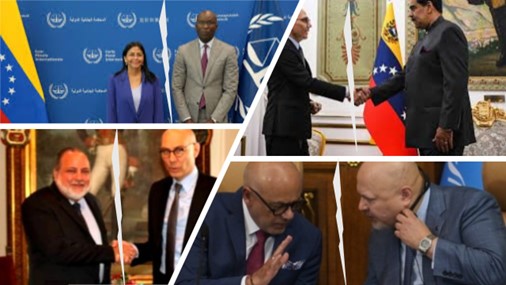
In just two weeks of December 2025, all the myths surrounding Venezuela’s supposed cooperation with international human rights organizations crumbled.
On the first day of the month, the Assembly of States Parties to the Rome Statute began when Deputy Prosecutor Mame Mandiaye Niang announced the closure of the Prosecutor’s office in Caracas, claiming that the Prosecutor’s Office “determined that real progress in complementarity has still been a challenge.” A diplomatic formula for saying what we already knew: Venezuela is not seriously investigating crimes against humanity, and the technical assistance the Prosecutor’s Office hoped to provide was falling on deaf ears.
Four days later, the report from the most recent meeting of the Global Alliance of National Human Rights Institutions (GANHRI) Accreditation Subcommittee was released, stating that the Ombudsman’s Office “is operating in a manner that seriously compromises its independence” and that it “has not demonstrated compliance with the minimum requirements of the Paris Principles.” As a consequence of this decision, the Ombudsman’s Office will lose, starting in 2026, its ability to participate with voice and vote in the international debates of UN human rights bodies and in the activities of GANHRI.
On the 11th of the same month, in reaction to the announcement by the Deputy Prosecutor of the ICC, the National Assembly unanimously approved the Law Repealing the Rome Statute, thereby withdrawing the country from the ICC as a member state after one year, although this will not affect ongoing investigations.
On December 16, the United Nations High Commissioner for Human Rights (OHCHR) informed the Human Rights Council: “I no longer have any international staff or personnel in the country. We have made every possible effort, but without success.” Although he did not rule out the possibility of having staff on the ground again, he stressed that he would “urgently need to define concrete measures that demonstrate a commitment to this type of cooperation.” This decision exacerbates the uncertainty that began in February 2024 when Venezuela expelled OHCHR staff in Caracas, only to then allow the team’s partial return in December 2024, which was followed by the repeated denial of visas to the officers remaining in Panama.
“We are witnessing a systematic pattern of non-compliance with Venezuela’s international commitments,” stated Ligia Bolívar, representing Aula Abierta, an organization that had the opportunity to speak during the Human Rights Council’s interactive dialogue on Venezuela on December 16.
It is worth recalling that in August 2025, AlertaVenezuela released a report based on a consultation involving 15 organizations that analyzed the recommendations accepted by Venezuela two years prior during the third cycle of the Universal Periodic Review (UPR). The report revealed that only 9.09% of the recommendations were partially implemented, while 40.9% were not implemented at all. Furthermore, half of the recommendations not only failed to show progress but also experienced significant regression. In addition, Provea reports that, since July 2021, the thematic mandates have sent 21 communications, and the government has only responded to one, refusing to provide information on the other 20. At the time of this analysis, the list of unanswered communications had risen to 23.
In just a few weeks, the de facto government has been exposed for its lack of political will to effectively comply with the international commitments it voluntarily accepted.
This confirms what we have warned on several occasions: that the appearance of cooperation is merely a mechanism to buy time and distract international organizations from their human rights mandates. The evidence is irrefutable: the State never had a genuine intention to cooperate, only to put on a show. Venezuela’s next step will be to deepen its isolation, which it has already begun by repealing the law that bound it to the Rome Statute and denying visas to the OHCHR field team. Unfortunately, amid the increasing politicization of the debate on international justice and human rights, some countries that identify as opposed to Maduro are ultimately playing into his hands by turning their backs on international human rights forums and remaining silent in the face of the US government’s attacks on the International Criminal Court.
Given this scenario, the international community must redouble its efforts to strengthen monitoring, protection, and accountability mechanisms for Venezuela, especially through decisive support for the work of the Independent International Fact-Finding Mission on Venezuela. The Mission operated with minimal resources over the past year, far below the proportion of cuts suffered by other mechanisms and bodies within the UN human rights system. The Mission’s role is fundamental in documenting serious human rights violations and identifying the chains of command that will allow for future accountability, whether before the ICC, universal jurisdiction, and/or in a potential transitional justice system, when circumstances permit. The fight against impunity in Venezuela depends on firm and effective support for the Mission’s work, as well as on rejecting attacks against the ICC and its judges, prosecutors, and officials.