
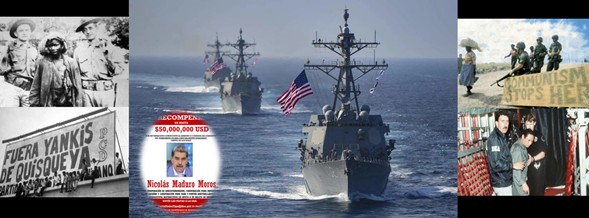
The deployment of a nuclear submarine, reconnaissance aircraft, several destroyers, and a ship equipped with guided missile launchers off the coast of Venezuela could set a very negative and dangerous precedent in the region. Just when it seemed that US military interventions in the region—not to mention plots to overthrow governments—were a thing of the past, that threat reemerges, constructed from a narrative rapidly imposed in the last month. This analysis does not focus on the possibility of an invasion, but rather on the implications of such a scenario for human rights, democracy, and governability.
On July 18, a prisoner exchange took place, with which the US managed to rescue all US citizens still detained in Venezuela. On July 25, the Treasury Department sanctioned the so-called Cartel of the Suns, “led by Nicolás Maduro Moros and other senior officials of the Maduro regime.” On August 7, the State Department increased the bounty on Nicolás Maduro from $25 million to $50 million. On August 13, the US Attorney General announced that assets worth $700 million belonging to Nicolás Maduro had been seized. On August 19, one month after the rescue of the last American hostages, various media outlets reported the deployment of US military vessels to the Caribbean Sea near Venezuela, with the aim of combating drug cartels. The vessels reportedly arrived near Venezuela on August 24.
According to the most recent report from the United Nations Office on Drugs and Crime (UNODC), Colombia is the world’s leading producer of cocaine. Most of this product is traded through Pacific ports, while there are two routes through the Caribbean, the Venezuelan Caribbean being one of them, but not the main one. If Trump’s concern is the fight against narcoterrorism, why aren’t the ships landing off the coast of Colombia?
Everything indicates that a narrative is being constructed that seeks only to justify US military action to remove Maduro from power, with no mention of the words “democracy,” “fraud,” or “human rights.”
This isn’t the first time that drug trafficking has been used as a banner to eliminate real or fictitious enemies. With the distance from this case, it’s worth remembering what the so-called war on drugs in Colombia meant in the 1980s. Under the guise of eradicating coca crops and ending cocaine production and export, it killed countless innocent people. This is also happening now with the criminalization of Venezuelan migrants accused of being members of the Tren de Aragua (Aragua Train) and expelled without any formality from the US, many returning to a Venezuela where their lives and freedom are at risk. These are wars against an enemy on a real basis, but with a larger fictional component that serves to justify atrocities.
This is also not the first time the US has constructed a narrative to justify armed intervention to depose those in power. Iraq is the most recent example. There were plenty of reasons to point to Hussein as a dictator, a human rights violator, but a seemingly less questionable reason was invoked, such as the existence of weapons of mass destruction. The evidence was never obtained; Hussein was tried and hanged, after which the country descended into a long civil war.
Cases like Iraq prompt reflection for Venezuela. If Maduro is the head of the cartel of the suns, will the problem end by eliminating him politically and/or physically? The cocaine that moves the cartel of the suns is produced in Colombia, and illegal armed groups from Colombia, such as the National Liberation Army (ELN) and the former FARC, operate in the middle and lower Orinoco, gaining strength as President Petro’s Total Peace proposal fails. Are the marines going to invade the jungle?
Meanwhile, Maduro plays the victim, unsuccessfully summoning so-called militias, of which only photos of elderly, thin, toothless men and even a woman with a broken arm remain. There is no doubt that the de facto government is nervous, as the threat feels very close. But so far, the only real effect has been the intensification of repression against a silenced and overwhelmed civil society that is criminalized for any critical comment on the tensions between the US and Venezuela. Twelve political prisoners were released on August 24, but the revolving door continues.
On the international stage, first Ecuador, and more recently Paraguay, Argentina, Trinidad Tobago and Guyana, joined in labeling the cartel of the suns as terrorists. The OAS Secretary General made a statement that should be concerning, coming from whom it comes, saying, “I’m not going to comment on anything bilateral. Security is important in the hemisphere, we know that, but what the member states do or don’t do individually, I’m not going to comment on that” (bold added). Meanwhile, Guterres remains silent, continuing his low and distant profile regarding everything related to Venezuela. Thus, Trump seems to be advancing in imposing his foreign policy in various arenas such as Ukraine, Palestine, and now Venezuela, outside the multilateralism that he despises and economically suffocates.
The international community must avoid endorsing a US initiative outside of multilateralism, as it neglects the centrality of human rights and democracy as the guiding principle of any pressure exerted on Venezuela.