
In the third cycle of the Universal Periodic Review (UPR), Venezuela accepted 221 of the 328 recommendations made by States. Many of the accepted recommendations were made by countries friendly to Venezuela, such as Belarus, Bolivia, China, Cuba, Indonesia, Mexico, Nicaragua, Russia, South Africa, Turkey, Vietnam, and Yemen, among others.
Venezuela recognizes the Universal Periodic Review as the only valid peer-to-peer human rights monitoring mechanism. Conversely, the Venezuelan State has repeatedly ignored the mandate of the Independent International Fact-Finding Mission on Venezuela, as well as the reports submitted by the Office of the United Nations High Commissioner for Human Rights (OHCHR), prepared based on Human Rights Council resolutions. Venezuela’s rejection of these mechanisms is based on arguments alleging selective monitoring practices in certain countries, as well as allegations of interference in internal affairs, because these mechanisms lack the consent of the state concerned to approve a resolution requesting special monitoring of that state.
Two years after the recommendations were made to Venezuela in the third cycle of the UPR, AlertaVenezuela conducted a consultation with civil society organizations that monitor this Human Rights Council mechanism. Fifteen organizations participated in the consultation, analyzing 88 of the 221 accepted recommendations. Each recommendation was assessed according to the degree of compliance by the Venezuelan state, according to four categories: fulfilled, partially fulfilled, unfulfilled, and in regression.
The results of the consultation are compiled in a report that presents a bleak assessment. None of the recommendations voluntarily accepted by Venezuela were fulfilled. Only 9.09% of the recommendations were partially met and 40.9% were unmet, while half of the recommendations not only showed no progress, but also showed significant regression, such as respect for civic space, the holding of transparent elections, the promotion of dialogue for national reconciliation, the strengthening of the Ombudsman’s Office, the development of the National Human Rights Plan, the adaptation of the prison system to the Mandela Rules, and the timely and impartial investigation of crimes such as enforced disappearances, arbitrary detentions, and excessive use of force.
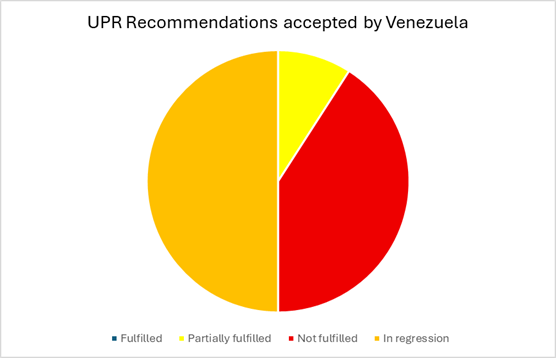
Even in areas such as economic, social, cultural, and environmental rights, regression prevails. Of eight recommendations, partial compliance was observed in one, non-compliance in five, and regression in two.
In this sense, the complete non-compliance with recommendations voluntarily accepted by the Venezuelan State contradicts its narrative of alleged cooperation with the international human rights protection system in peer review forums, even when these recommendations were formulated by friendly countries and accepted by the state concerned.
Venezuela has attempted to use alleged selectivity as an excuse to ignore the mandate of the Independent International Fact-Finding Mission on Venezuela, as well as the reports submitted by the OHCHR. The hypocrisy of the de facto government reaches the point of rejecting selectivity when it comes to accountability for the serious human rights violations that have occurred in the country, on the one hand, and demanding, on the other, an individualized examination of the situation in Palestine and the deportations of Venezuelans to El Salvador, to mention just two recent cases. Venezuela deliberately ignores the existence of an Independent International Commission of Inquiry (IOC) on the Occupied Palestinian Territory, including East Jerusalem, and Israel, and a Special Rapporteur on the situation of human rights in the Palestinian territories occupied since 1967, a special procedure that the Israeli government ignores and refuses to cooperate with, and whose rapporteur was recently sanctioned by the US and Israel. In addition, eleven UN mandates expressed their concern about illegal deportations from the United States to El Salvador.
The UN human rights system has responded to the terrifying situations in Palestine and El Salvador, among many others, by applying exactly the same standard it applies to Venezuela, based on the fact that interference or selectivity cannot be alleged when speaking out against serious human rights violations. It is Venezuela that chooses to invoke any excuse, however flimsy, to try to escape international scrutiny. The international community must reject the blackmail of Venezuela’s double standards and accept that, if the de facto government fails to comply even with the recommendations made by its friends, it is because it lacks any genuine interest in protecting human rights. Therefore, silence or silent diplomacy are not options when interacting with a government that disregards the life and liberty of its citizens. Likewise, the evident lack of cooperation in the protection of human rights should prompt other international justice mechanisms, such as the Office of the Prosecutor of the International Criminal Court, to reconsider their working strategy vis-à-vis Venezuela, as it still insists on an idea of positive complementarity with the local justice system that has no basis in reality.