
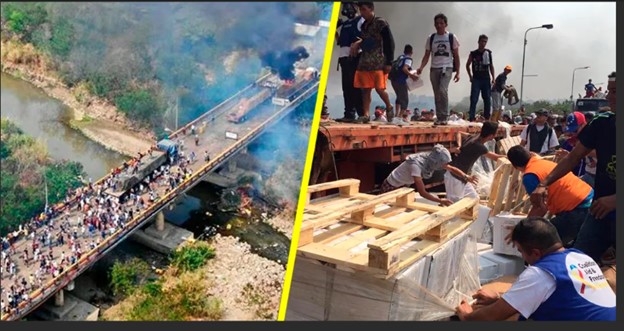
Two weeks after the new administration took office in the United States, the world of human rights, humanitarian work, development and peace operations, and other areas of social interest, was put in check with the unprecedented decision to freeze, immediately and for up to 90 days, funds for foreign aid. Added to this is the possibility that USAID, the well-known United States Agency for International Development in charge of providing humanitarian assistance abroad, will disappear.
The impact at a global level was not long in being felt. According to news agencies, dozens of senior officials have been suspended, thousands of regional contractors have been fired and, at a local level, on Monday USAID employees were told not to enter their headquarters in Washington. In addition, their website and their account on the X platform were taken down. As the Washington Office on Latin America (WOLA) points out, thousands of “implementing partners” have been forced to cancel events, lay off staff, and determine how or if they will be able to meet their previous commitments, leaving them in a sudden state of uncertainty and lack of protection.
In view of the uproar that this caused, the State Department has reversed course and taken the step of excluding “life-saving humanitarian assistance” from this freeze. Even so, most programs remain on hold for the long term, mainly because there is confusion about which programs are exempt from the suspension orders, as well as the fear of losing aid permanently, which has created a deterrent effect when it comes to implementing certain programs.
In the case of Venezuela, the impact comes in a context of fierce repression and control of the population through a policy of state terrorism that seeks to consolidate a de facto government. The measure comes at a time when the NGO oversight law is starting to restrict the ability of civil society to function, serving to criminalize organizations, activists, and independent media that receive foreign funding, particularly from the United States. Thus, the more pronounced closure of civic space and the commission of new crimes against humanity are latent concerns in the face of a social fabric already cracked by the Maduro government.
WOLA provides other arguments that deserve special attention. The freezing of aid not only affects the democratic struggle at the internal level, but also humanitarian assistance to Venezuelans inside and outside the country through integration efforts, food, health, livelihoods, protection, nutrition, sanitation, and water. In its view, if the needs of host communities are not addressed, nor are vulnerable populations seeking protection in other, closer countries supported, the strict approach based on border securitization will lead to greater secondary migration to the United States, worsening already difficult humanitarian situations in several countries along the migration route. The extent to which these measures not only harm Venezuelans, but also the interests of the donor country itself must be considered.
The US government’s approach of carrying out an individual assessment of each aid program is an objective outlined as part of a foreign policy restructuring effort, which is within its jurisdiction to resolve. However, due to a fundamental principle of legal certainty and good faith in the commitments made, it is not admissible to freeze funds, and thus halt work, without prior notice and without a guarantee of resumption at least for the time being, as if there were no human lives, and even entire populations, dependent on funded programs. While decisions on the matter are being adopted, which must always involve the US Congress, the flow of funds should be resumed and clear terms of their validity established, with sufficient guarantees for all partners. A decision that does not conform to these parameters does more damage at the local, regional and international levels than the freezing measure, which is not yet defined, would seek to avoid.
AlertaVenezuela calls on the international community to continue to monitor the evolution of this restructuring process, considering that in less than 85 days a political reformulation in terms of assistance should result, and asks the allies of the democratic cause of Venezuela to continue supporting the efforts of civil society to maintain its work of promotion and protection of human rights and humanitarian assistance in the midst of a complex humanitarian emergency that adds complications to this political labyrinth.